“Brightmont gave my daughter
confidence and helped her love learning
again.”
– Parent of 8th grader
400 E. Main St. Barrington, IL 60010
1-888-521-0887
inquiry@brightmontacademy.com
It’s easy to assume that students who are struggling in school simply need more time with the material. While additional practice is certainly part of the equation, the root challenge for neurodivergent learners often runs deeper. These students have the potential to succeed, but a traditional classroom may not always provide the flexibility or individualized instruction they need.
Tailored tutoring for ADHD can break the cycle. Instead of continuing to hammer the same material in the same way, specialized learning programs address underlying challenges with new approaches and help students regain their academic confidence. The right tutoring program not only helps students with ADHD to catch up or get ahead in specific classes but also strengthens their executive functioning skills and helps them navigate their attention deficits.
In this guide, we’ll explore the basics of tutoring for ADHD students, including:
Let’s dive in!

Attention-Deficit/Hyperactivity Disorder (ADHD) is a neurodevelopmental disorder characterized by:
Different kids will display these symptoms to different degrees. While some will have a predominantly inattentive presentation, others will exhibit more hyperactive and impulsive tendencies, and others will have a combined presentation.
ADHD in children is quite common, with
11.7% of U.S. children between the ages of 3 and 17 having a diagnosis. Despite this prevalence, traditional schools are still often underprepared to accommodate the learning needs of this population.
Tutoring for ADHD helps students build essential academic and executive functioning skills. By providing a personalized, low-distraction environment, specialized tutoring addresses the unique attention-related and organizational challenges associated with ADHD.
Beyond rote memorization, tutoring for attention deficits helps students develop study strategies that support their learning in the long term across all subjects.
Standard tutoring typically re-teaches the curriculum, whereas ADHD tutoring adapts pedagogy to match the student's level of attention. If a student loses focus, a tutor who truly understands ADHD can provide a brief movement break or adjust their instructional approach to reengage the student.
ADHD tutoring also deliberately minimizes the sensory overload and distractions commonly found in standard group tutoring settings. Removing background noise and visual clutter creates an environment more conducive to these students’ learning.
Yes! Effective ADHD tutoring weaves organization, task initiation, and time management directly into core academic lessons. In addition to learning specific course-based concepts like math or history, students also learn how to learn.
If your primary focus is on building these foundational skills for your child, consider seeking out
executive functioning coaching. In these programs, students work with an instructor who will review their schedule and workload to help them create a plan that works for them so they’ll be able to complete and turn in every assignment.
Signs that a student with ADHD needs additional support include:
Pay attention to both academic and
emotional challenges your child may be facing. When a student starts struggling in one area, the other will likely follow. Talk to your child about how they feel their ADHD is impacting their learning and whether their teachers are willing to accommodate their
learning needs.
Traditional, overcrowded classrooms rarely provide the unique support that students with ADHD need to thrive. Sensory overload and one-size-fits-all pacing make it hard to maintain focus and can damage students’ academic performance and confidence.
By contrast, learning environments tailored to the needs of students with ADHD can transform students’ academic and emotional wellbeing. The ideal
classroom for ADHD offers:
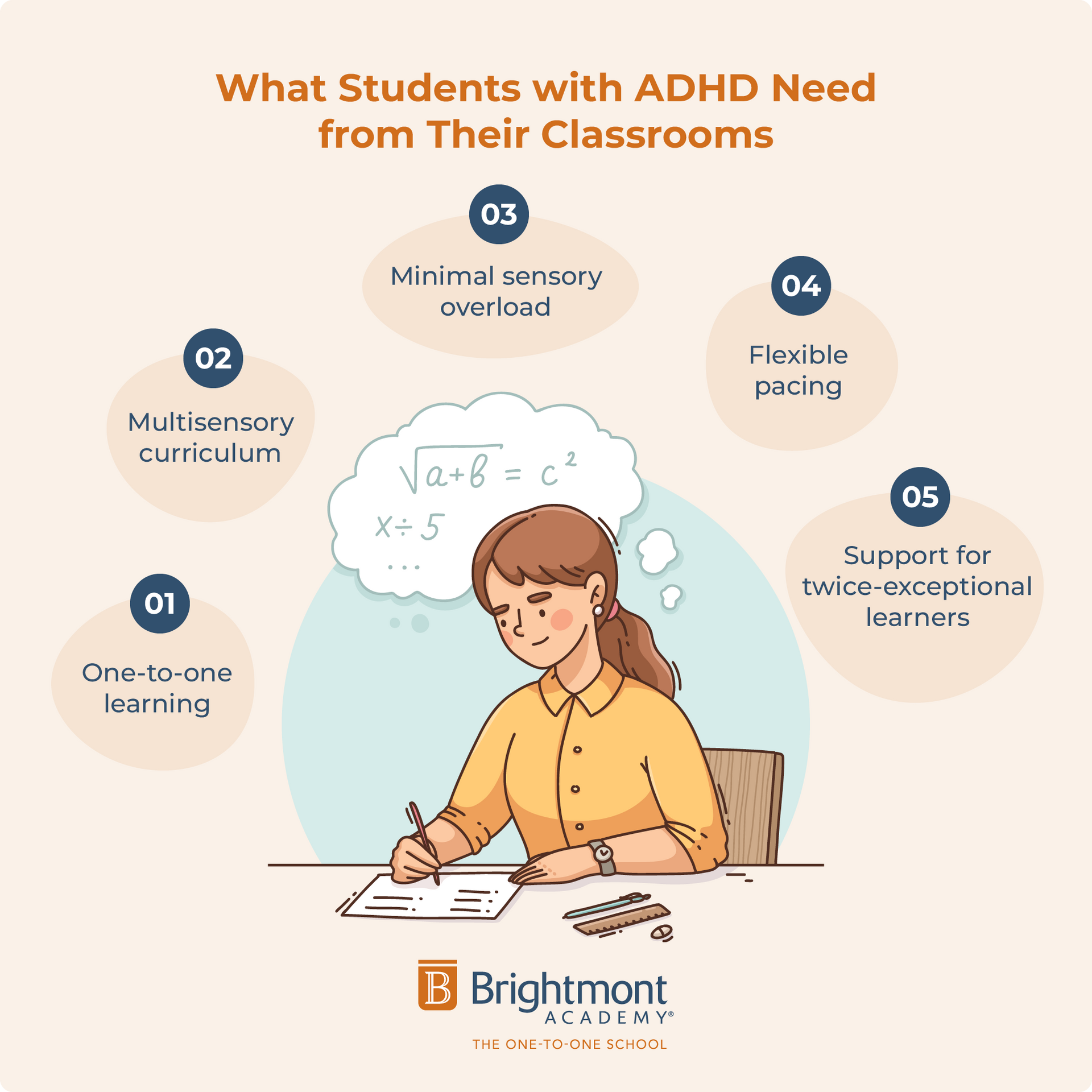

Tutoring for students with ADHD fills the gaps left by standard classrooms and gives them a chance to learn in ways that make sense to them. Not all tutoring programs for ADHD, however, are created equal—let’s look at a few common options.
Traditional tutoring centers typically rely on small-group instruction, where a teacher's attention is divided among multiple students. While these programs offer additional instructional time and often have a smaller student-to-teacher ratio than your average classroom, they usually don’t offer the specialized support that students with ADHD need to succeed.
These specialized programs prioritize foundational skills as well as specific course material, usually focusing on building executive functioning skills. Kids with ADHD frequently struggle with executive functioning—that is, the process of creating and following through on goals. Coaches can help them create good study habits that work for them. Students will carry the skills they build in these sessions throughout the rest of their academic career and into their personal and professional lives beyond the classroom.
This model pairs your student with a teacher who understands their unique learning style and adjusts the curriculum, pacing, and instructional method accordingly. When a learning environment has just one teacher and one student, students can ask questions without fear of peer judgment, and teachers can more easily pinpoint the moment a student loses focus to get them back on track.
Personalized learning classrooms enable mastery-based instruction, where students only move forward once they’ve demonstrated complete understanding of a topic. Instead of simply moving on to the next unit because the calendar dictates it, students learn at a pace that works for them. This approach helps students improve their academic performance by providing a solid foundation of understanding.

To find the right tutoring program for your student with ADHD, you need to evaluate providers for their ability to teach in the way your child learns best. Ideally, tutoring should focus on foundational skill-building as well as subject matter-specific review.
Consider the following questions to get a full understanding of how a specific tutoring program will serve your child with ADHD:
You should also share which areas of executive functioning your child struggles with most to see how a tutoring program will support your child’s growth. Take the short quiz below to determine which skill areas your tutoring should focus on:
To maximize the impact of this support, consider involving your child in the tutor selection process. When students feel ownership over their academic interventions, they tend to engage more willingly and experience faster progress.
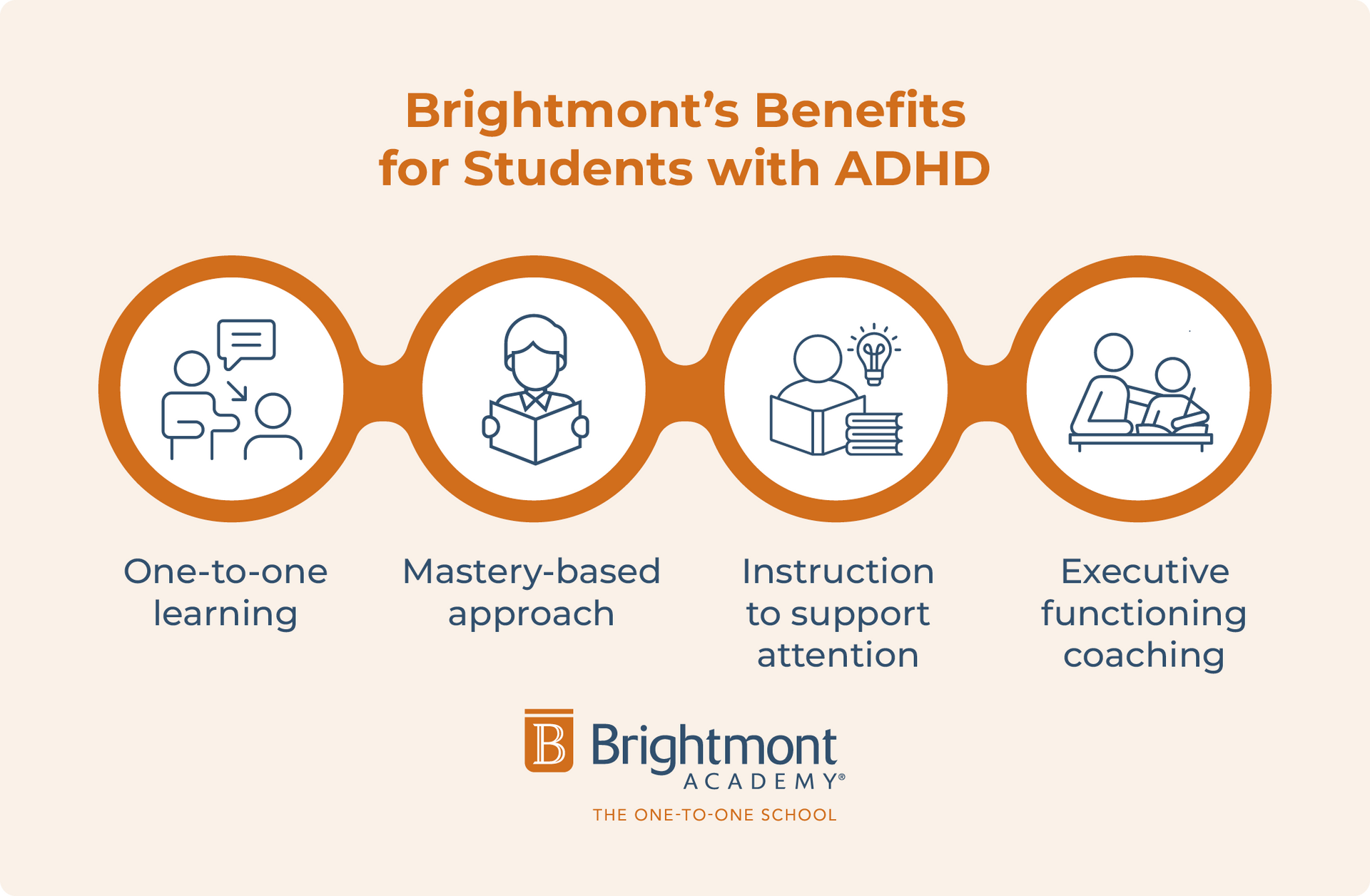
Brightmont Academy’s one-to-one mastery-based model is the ultimate solution for students with ADHD, providing a customized, low-distraction environment. We help students with ADHD work through obstacles and accelerate their academic progress, which, in turn, builds their confidence and reignites their love of learning. Brightmont offers nationally accredited full-time school, tutoring, and skill-building programs for students in grades K–12.
Benefits of a Brightmont education for students with ADHD include:
Brightmont’s podcast, hosted by ADHD coach Griffin Rouse, emphasizes how the personalized learning environment is transformative for students with attention deficits.

Navigating ADHD tutoring doesn’t have to be a stressful process for your family. By prioritizing instructional models that blend academic support with executive function coaching, you’ll give your student the tools they need to thrive.
Looking for more ways to support your student with ADHD? Brightmont is here to help. Learn more about how the right educational model helps neurodivergent students succeed academically, socially, and emotionally in the resources below:









“Brightmont gave my daughter
confidence and helped her love learning
again.”
– Parent of 8th grader

92% of Brightmont graduates are
accepted into their first-choice college

(888) 521-0887
To book a tour, talk to a campus director, or get a free consultation, please fill out the form.

©2026 Brightmont Academy®
