“Brightmont gave my daughter
confidence and helped her love learning
again.”
– Parent of 8th grader
400 E. Main St. Barrington, IL 60010
1-888-521-0887
inquiry@brightmontacademy.com
If you're the parent of a child who struggles with anxiety, depression, or another emotional disorder, you already know that "just try harder" isn't advice—it's a dead end. Nationwide, more than 20% of young people show signs of an anxiety disorder, and nearly 40% of high school students report persistent feelings of sadness or hopelessness. These aren't rare struggles happening to someone else's kid. They're happening in classrooms everywhere, often to bright, capable students who simply can't reach their full potential in an environment that wasn't built with them in mind.
Traditional schools, for all their strengths, still tend to run on a one-size-fits-all model: fixed schedules, large classes, constant social comparison, and little room to slow down when a student needs it. For a child managing an emotional challenge, that environment can turn school from a place of growth into a daily source of stress.
Luckily, alternative schools around the country are providing creative, research-based educational models that provide holistic support.
In this article, we’ll cover:

Emotional disorders encompass a range of mental health challenges, including anxiety, depression, and bipolar disorder, which necessitate specialized educational approaches. Although these conditions present quite differently, most share a common thread: they change how a student experiences the everyday demands of school, sometimes in ways that aren't obvious from the outside.
Over time, these conditions profoundly impact a student’s learning needs by:
Traditional classrooms, with their packed schedules and constant sensory overload, tend to amplify these challenges rather than ease them. That's why it’s important to explore schools that are specifically designed to accommodate the needs of students with emotional disorders so that your child can receive the support they need.
Students with emotional disorders require accommodations that minimize classroom overwhelm and peer pressure. Essential supports include:
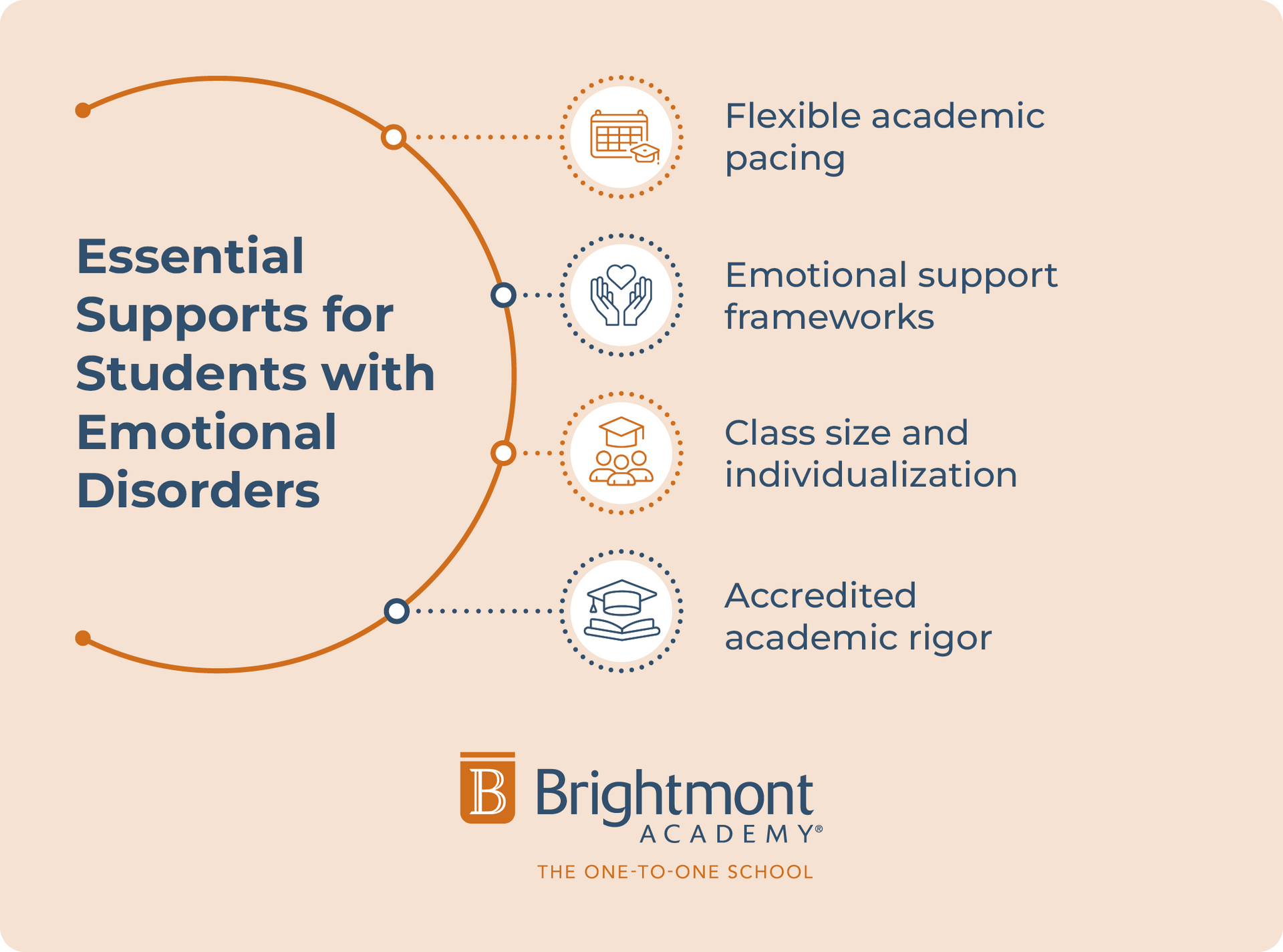
With the right mix of these accommodations in place, students with emotional disorders can make real progress, often faster than parents expect once the right environment is in place.
The best private schools for anxiety and emotional disorders offer customized curricula and empathetic environments. The following schools are uniquely designed to support complex academic and emotional needs.
Brightmont Academy is a school with campuses across the U.S. offering a fully accredited, one-to-one instructional model. This means that in every class, your child works directly with a teacher entirely focused on their educational experience.
The benefits of personalized learning for students with emotional disorders include:
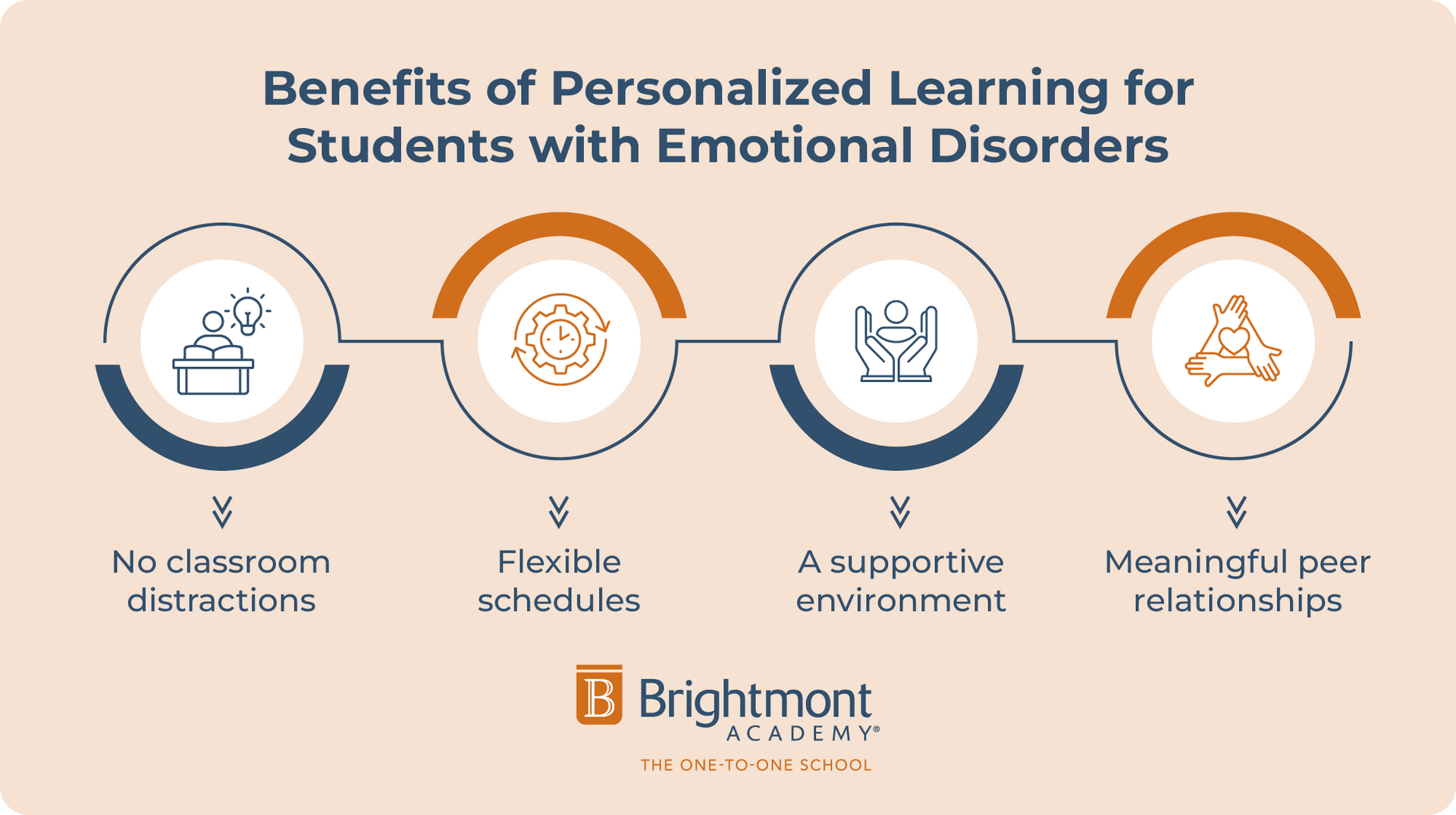
Brightmont offers full-time, part-time, tutoring, and test-prep options, so families can choose the level of support that best fits their child's needs.

Located in Maryland, the McLean School pairs small class sizes with comprehensive learning support built into a traditional college-prep curriculum. To help students manage anxiety, the school implements a school-wide mindfulness program, giving students practical tools for regulating stress without stepping outside the standard academic track.
Winston Preparatory School, with campuses in New York, New Jersey, and Connecticut, builds its program around highly individualized daily focus sessions. Teachers utilize continuous feedback loops to adapt to specific learning profiles and emotional needs.
The Craig School in New Jersey combines evidence-based academic strategies for both learning and addressing emotional needs. A strong emphasis on teaching practical organizational skills alongside robust emotional support helps students build a foundation for their future academic journey.
Eagle Hill School, with campuses in Massachusetts and Connecticut, is designed for a wide range of learning profiles. The school’s unique nine-part academic day keeps students engaged without overwhelming them.
Based in Illinois, Lawrence Hall Therapeutic Day School builds individualized education programs specifically for youth who have experienced childhood trauma. Academics are complemented with a comprehensive visual art and therapeutic recreation program that promotes anxiety release and more engaged learning.
The Oliverian School, a boarding school in New Hampshire, is built to bridge the gap between heavy support and genuine independence. It's a strong option for students dealing with anxiety, depression, or school refusal, offering small-group, highly individualized support in a residential setting.
The Brehm Preparatory School in Illinois takes a holistic approach for students with complex needs. Its family-style boarding environment is designed to address academics and emotional well-being together, rather than treating them as separate concerns.
Ignite Learning Academy is a completely online school offering 24/7 course access that enables students to work whenever and wherever it’s convenient for them. Their educational model follows a 1+1+1 approach, including the student, their teacher, and an at-home support figure (usually a parent). Online school may be a good fit for students who are profoundly struggling with maintaining consistent schedules.
Securing a supportive educational environment for a child with an emotional disorder isn't just about academics—it's about giving them a place where they can feel safe enough to actually learn. By opting for personalized learning and one-to-one instruction, you give your child the opportunity to thrive in an environment specifically designed to alleviate anxiety and accommodate unique learning styles.






“Brightmont gave my daughter
confidence and helped her love learning
again.”
– Parent of 8th grader

92% of Brightmont graduates are
accepted into their first-choice college

(888) 521-0887
To book a tour, talk to a campus director, or get a free consultation, please fill out the form.

©2026 Brightmont Academy®
