“Brightmont gave my daughter
confidence and helped her love learning
again.”
– Parent of 8th grader
400 E. Main St. Barrington, IL 60010
1-888-521-0887
inquiry@brightmontacademy.com
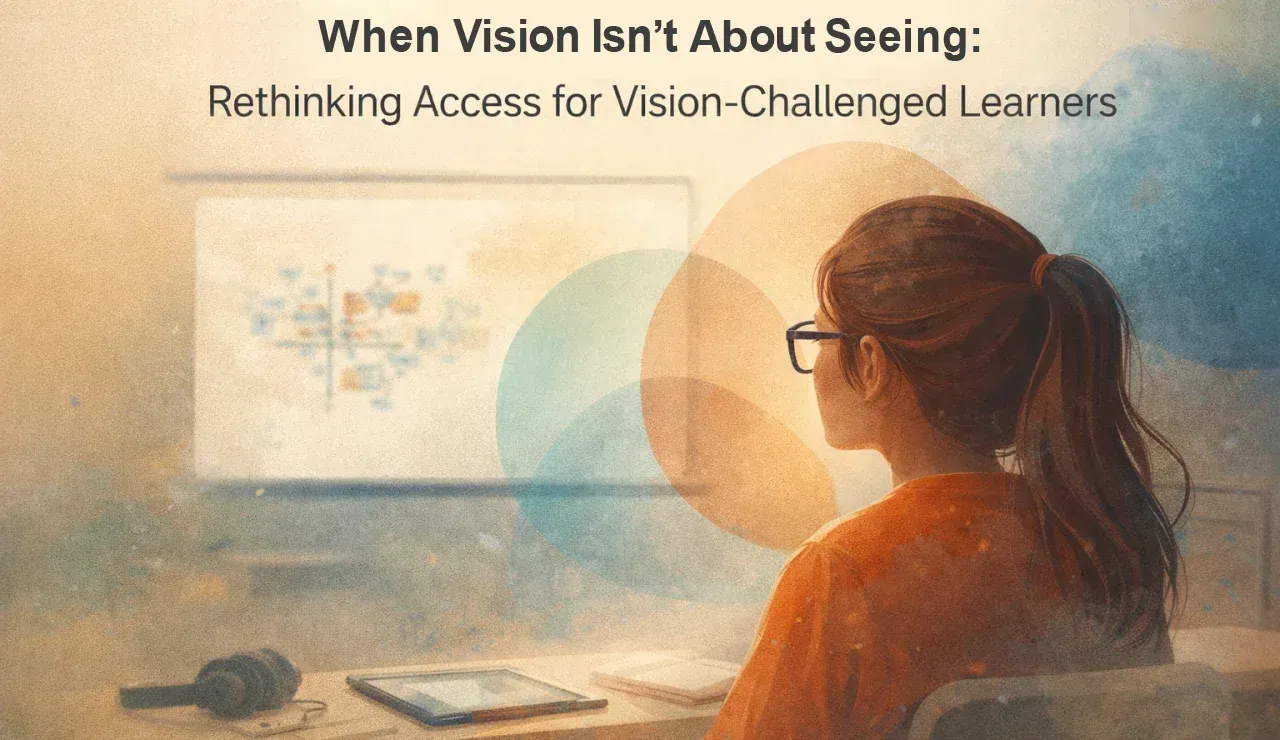
When we talk about learning differences, vision is often treated as one of the simplest variables to address. The solutions we reach for are familiar in recommending glasses, larger print, or a seat closer to the board. These supports can be helpful, but they are often built on an assumption that vision is primarily about clarity.
In my work with neurodivergent and vision-challenged students at Brightmont Academy, I’ve learned that vision is rarely that simple.
I’ve worked with learners who have Cortical Visual Impairment (CVI), neurological vision challenges, and progressive vision loss. One student I worked with began losing her sight in 10th grade and is now legally blind. What stood out most was not only how her vision changed, but how quickly expectations around her learning shifted alongside it. The challenge was never her ability. It was her access.
For many learners, vision is not just about what the eyes detect, but how the brain processes, organizes, and sustains visual information. When that distinction is misunderstood, even well-intentioned accommodations can easily miss the mark.

Vision challenges, particularly those involving neurological processing, often result in inconsistent access. What we’ve seen is that fatigue, lighting, visual clutter, sensory load, and stress all play a role. I’ve seen students engage deeply with material one day and struggle the next, because the visual demands of the environment had changed. An important point to remember is that when access fluctuates, performance will also fluctuate.
One common misconception is equating vision with eyesight. A student can pass a vision screening and still struggle to make sense of visual information in real-world learning environments. In these cases, clearer text or corrective lenses alone don’t resolve the underlying challenge.
Another assumption is that if a student can access material successfully once, they should always be able to do so. Vision needs are rarely static. Removing supports because a learner “did fine yesterday” can unintentionally remove access today.
I’ve also worked with students who processed information more effectively when they looked away, reduced visual input, or relied on auditory channels. In these cases, visual attention was not a reliable indicator of engagement. In fact, requiring sustained visual focus often reduced comprehension rather than improving it.
Well-intentioned visual supports can also become barriers. Classrooms filled with posters, slides, charts, and color-coding may feel supportive, but for some vision-challenged learners, this level of visual input becomes overwhelming. Without careful simplification, more visuals can actually mean less access. When vision challenges are misunderstood, learners are often labeled as inattentive, inconsistent, or unmotivated. I’ve seen students internalize those labels while continuing to work hard to navigate environments that weren’t designed for how they process information.
The student who lost her vision in high school didn’t need lowered expectations or modified standards, she needed flexibility, patience, and instruction that adapted as her access changed. When those supports were in place, her engagement, confidence, and independence followed.

Working at 𝗕𝗿𝗶𝗴𝗵𝘁𝗺𝗼𝗻𝘁 𝗔𝗰𝗮𝗱𝗲𝗺𝘆 has reinforced for me how powerful individualized instruction can be. When pacing, class size, and instructional approach are flexible, educators can respond to how a student accesses learning and not just how learning is traditionally delivered.
Instead of asking, “What does this student see?” a more meaningful question is, “How does this student access information most effectively right now?” That changes the expectations, instruction, and outcomes.
Vision-challenged learners need learning environments that reduce unnecessary visual demands, respect neurological processing, and adapt as needs evolve. When we move past the assumptive generalizations we have about vision, we start building access where it is truly helpful.
Thanks for reading 𝗧𝗮𝗯𝗹𝗲 𝗧𝗮𝗹𝗸𝘀 𝘄𝗶𝘁𝗵 𝗧𝗼𝗻𝘆 . This article reflects my original writing and lived experience. Feel free to share the link or repost, but please don’t republish or copy the content without permission. © 2025 Tony Beals. All rights reserved.

Tony Beals is the VP of Admissions and Enrollment Solutions at Brightmont Academy. Tony has extensive experience as both a parent and an educator working with students from an array of backgrounds including those with anxiety, depression, ASD, ADHD, and ODD. He has been in the education industry for over 25 years and has been involved as a teacher, consultant, manager, and leader.





“Brightmont gave my daughter
confidence and helped her love learning
again.”
– Parent of 8th grader

92% of Brightmont graduates are
accepted into their first-choice college

(888) 521-0887

To book a tour, talk to a campus director, or get a free consultation, please fill out the form.

©2026 Brightmont Academy®
